
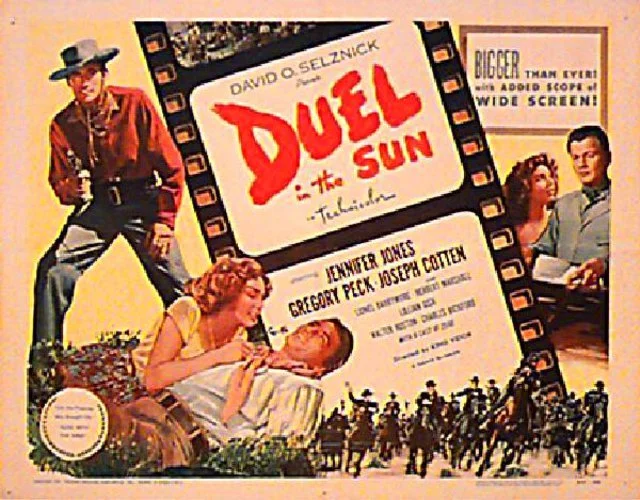
Duel in the Sun (1946) was a selection of the 2023 Go West Film Festival. Opinions expressed here are those of the author and do not necessarily represent the views of the Go West Film Festival.
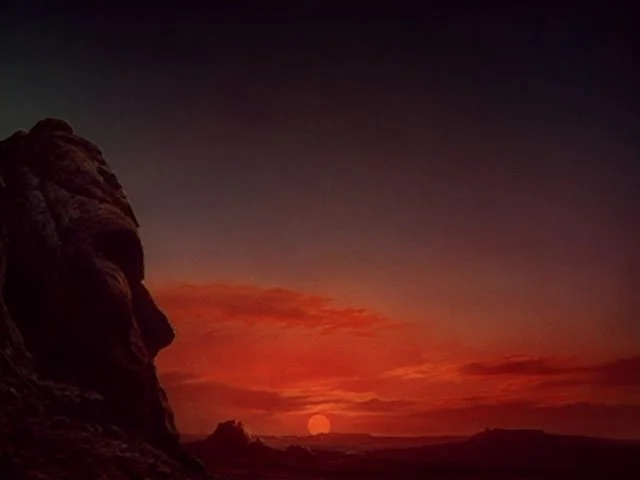
At the beginning of Duel in the Sun, we are asked to ponder an imposing rock face that gazes over a sunbaked desert landscape. Is the figure male or female? Does it suggest any particular ethnic identity? Is it natural landscape or a studio creation? While we consider these questions, a motley medley by composer Dimitri Tiomkin entertains us on the soundtrack of a film credited to a medley of multiple directors and cinematographers. After a few minutes, the concert does not so much entertain us as it tries our diminished contemporary patience. In the meantime, we sidestep the gender question, since geology tends to be neutral, or at most androgynous. Along with its ambiguous gender, the ethnicity of the rock face likewise remains up for grabs. Close inspection gradually reveals that the stone personage on the screen is not real. It is a pre-digital, pre-AI artistic rendering. However, a desert flower with naturally real features replaces the rock face in our field of vision, and the musical prelude ends. A musical overture begins. A voice-over narrator gives us heads up, as it were, about the weighty themes we are about to encounter in a motion picture that was "two years in the making." The film's origins with producer David O. Selznick, who at the time was riding a wave of success from his immensely popular Gone with the Wind, help explain the grandiose introduction to Duel in the Sun. Can a movie released in 1946 that swaggers onto the screen with such outmoded bombast possibly have anything to say to jaded audiences in the second decade of the 21st century?
Yes.
The craggy head basking in the sun turns out to be Squaw's Head Rock. More about that spot later, but suffice it to say that the journey to Squaw's Head, and the viewer's long-haul expedition through David O. Selznick's 129-minute cinematic extravaganza, while sometimes arduous, are well worth taking. After all, most treks across the Old West were both challenging and rewarding. Thanks to the western, they remain so today. Duel in the Sun unexpectedly strikes chords with contemporary viewers who are more exposed than ever to dangerously raucous politics and to questions of gender, masculinity, and race. Importantly, David O. Selznick's production is also a key contributor to several cinematic tropes and trends that follow.
Squaw's Head Rock is just plausible enough and just fake enough to remind us on the one hand of naturally molded features that dot the West, and on the other hand of cartoon and comic book renderings. Artists have replicated and exaggerated such fantastical landscapes since the early 20th century, all the way up to Martin Kove's 2023 western comic Prodigal Son. The stone head in the film's opening shot is a nod both to the West's immutable natural beauty and to transitory human creativity. Decades after its making, Duel in the Sun continues to reflect enduring truths as well as fleeting dreams.
★ From the Festival That Brings You These Essays ★
This Film Played Our Festival
Duel in the Sun screened at the 2023 Go West Film Festival. Every November we bring westerns like it back to the big screen in downtown Greeley — free, the way movie-going ought to be at least once a year.
NOVEMBER 9–14, 2026 · KRESS CINEMA & LOUNGE · FREE
DISCOVER THE FESTIVAL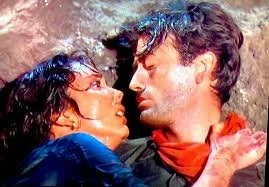
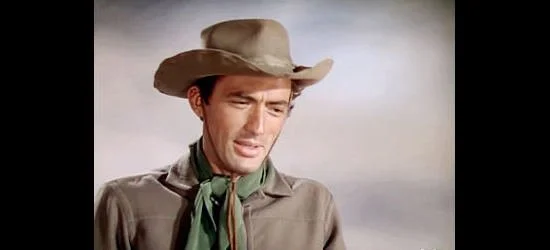
Kove's comic Prodigal Son, with its orphaned main figure, is only one among many representations of the West to incorporate this emblematic character type. Parentless or poorly parented loners often use the Western landscape as a canvas for their palette of emotional turmoil, as in Bad Company (1972), Orphan Train (1979), Young Guns (1988), and Slow West (2015), among others. Selznick's screenplay for Duel in the Sun makes both badboy Lewt McCanles (Gregory Peck) and orphaned bad girl Pearl Chavez (Jennifer Jones) key influencers for subsequent movie prodigals. The duel referred to in the title departs from the western's mainstay of faceoffs on a dusty street, though the film includes one of those confrontations as well. Lewt and Pearl are prodigal soulmates whose divergent goals set them on a deadly collision course (spoiler alert). Neither of them returns from the trek to Squaw's Head Rock.
The family origin story of biracial Pearl Chavez is as diverse and obscure as Dimitri Tiomkin's musical mishmash of Latin orchestrations, waltzes, folk melodies, the tune "Beautiful Dreamer," and the percussive clopping of horses' hooves. Pearl's father (Herbert Marshall) is a refined Southern gentleman residing in New Orleans. The girl's mother (Tilly Losch) is a libertine who dances atop a New Orleans saloon bar firing pistols in front of wolf-howling men, some of whom she invites into her bed. Mrs. Chavez is said to be of Native American heritage, though she and her daughter Pearl prefer to dress in Mexican fashion. The filmmakers elide ethnic distinctiveness within the Chavez family and generally offer two vague categories in the overall narrative: white Europeans and the Others. The blurry racial fault line is only one of many sources of tension in the film, and it is no coincidence that the high-angle photography of Mrs. Chavez galloping around a square-shaped bar appears at first glance to recreate a boxing ring. The stage is set for a duel.
Pearl and her mother are the only figures in the film who look directly into the camera. We first see each of them as they twirl in separate solo dances, during which each woman engages our observance of her performance by establishing a mutual gaze. Actor Tilly Losch as Pearl's mother pierces the fourth wall by bending backward in the arms of a lascivious fan and lowering her head toward the camera lens in mid-dance. In conventional filmmaking the character's brief, cheeky gaze into the eyes of the film viewers is a cinematic taboo. Her brazenness, however, is tempered by her distorted view of any reality beyond the immediate moment. The dancer, viewing the world upside down, has no idea of the price she will pay for her topsy-turvy perspective of tradition and transgression. Moments later, her husband will murder her.
The daughter's more innocent, yet likewise forbidden gaze into the camera during her dance portends other off-limits focal points in the course of the narrative. Unforeseen temptations and consequential penance await Pearl out West at an unforgiving place known as Squaw's Head Rock.

Selznick served as the film's principal writer. One of his primary strategies is to exploit fully the always reliable rivalry between good and bad. Despite ominous signs, the viewer can hope that Pearl will not replicate her parents' moral failures. Moments before he is hanged for killing Pearl's mother, father tells daughter, "You've been a good child, Pearl. Through some miracle, you're good." He arranges for Pearl to live with his second cousin and unrequited former love Laura Belle (Lillian Gish). Laura Belle has married Senator Jackson McCanles, a wealthy Yankee rancher who made his fortune in Texas cattle country. She has borne her husband two strapping sons. Though McCanles dislikes Pearl's biracial identity and considers her father to have been a worthless aristocrat, he agrees to give her a home on the ranch.
Upon arriving, Pearl offers Laura Belle the credentials her father assigned to her: "I'm a good girl."
It requires some effort to fix in mind Pearl's relationship to the McCanles ranch. The newcomer is not a stepdaughter, a stepsister, a niece, a close cousin, or even a friend of the family. Her obscure connection to the other principal characters becomes part of her exotic enticement. Pearl is not enough of a blood relative of the McCanleses to be off limits to the rancher's two sons, both bachelors. She joins the household alongside genteel Jesse (Joseph Cotten) and his younger sibling, lustful Lewt (Gregory Peck). However, soon after her entry into the male-dominated ranching environment, Pearl equivocates slightly with regard to her moral fortitude, suggesting that it might be a work in progress: "I'll be a good girl." A local religious leader (Walter Huston) seeks to keep the girl on a virtuous path. Popularly known as the Sinkiller, the preacher has already been preordained as a charlatan by the voice-over narrator who was heard during the film's overture. The Sinkiller's formula of genuflection and jewelry seems hopeless from the start. A badge of righteousness that the evangelist requires Pearl to wear in the form of a necklace eventually ends up at the bottom of the pond where she skinny-dips to Lewt's leering spectatorship.
After his murder confession and death sentence, Pearl's father went willingly to the gallows, hoping that contrite self-sacrifice would spare his daughter what he calls "the sins of the fathers." The father-daughter relationship consists of devotion and delinquency in equal measure. Their bond mirrors the father-son dynamic at the McCanles ranch between Lewt and the family patriarch, including a similar level of intergenerational admiration. The elder McCanles, however, is much slower than his counterpart, the elder Chavez, in accepting responsibility for wrongdoing. Not unlike Pearl's reverence for her tragically homicidal father, Lewt tells his irascible dad "I hope someday I'll be like you." The compliment is fawning but probably honest, and it accomplishes the desired result of a $1600 restitution for one of Lewt's saloon-smashing benders. The financial generosity is topped off by paternal praise: "What a boy!"
Unlike Lewt, Pearl naively aspires to the level of perfection suggested by her name. In particular, she hopes not to replicate her parents' flawed marriage. However, the "beautiful dream" which the film's theme music might suggest for her is powerless against the repellent seduction of Lewt's lewdness.
Pearl succumbs to his advances when Lewt interrupts her as she scrubs a floor, metaphorically acknowledging a debasement that is conveyed from her lowly POV as she and the camera peer up at her looming abuser. The preacher's talisman around her neck does not protect her from the fall. Indeed, the necklace, which she received from the Sinkiller while she stood before him in a state of undress, merely signifies yet another exploitation of her moral dilemma by yet another abusive male. Cynical possessiveness has lurked all along behind both the preacher's exhortations and Lewt's patronizing flirtations at the swimming hole, the corral, and at the ranch's gateway bell. The carnal consummation of the floor scrubber's relationship to her irresistible nemesis scours away a veneer of playful naughtiness and exposes the hard surface that underlies it. Thanks to the film's sound director, James G. Stewart, the life-changing sexual encounter is accompanied by a change in the weather. A thunderstorm can be heard outside, portending the deluge traditionally associated with the consequences of transgression. Pearl's victimization, in tandem with her lapse, reveals her kinship to her entangled and disgraced mother. Eventually she will also come to emulate the cold-blooded grit of her father who, when he was betrayed, killed the person he once loved.

Tellingly, the tawdry encounter between Pearl and Lewt occurs at night. Indeed, Lewt often operates as a nocturnal creature, whether carousing in El Paso saloons, crooning an evening siren song for Pearl's benefit, humiliating her at a dance, gunning down a hapless rival suitor in the dark, or clandestinely meeting his father after sunset for another financial handout before high tailing it as a fugitive. Lewt's first appearance in the film is at twilight, with just enough light left for his gaze to ravage Pearl's figure. By contrast, Lewt's brother Jesse, his corduroy coruscating under a cloudless sky, is the fellow who showed up bright and early to welcome Pearl upon her arrival in the nearby town of Paradise Flats.
Pearl is dressed in black in this arrival scene. The mourning clothes with which she pays respect to her deceased father are merely a fleeting allusion to his hope that Pearl avoid the dark, unvirtuous ways of her mother. However, even as the newly arrived stranger rebuffs Jesse's initial greeting, she quickly assumes the role of temptress and symbolically bites into an apple as Jesse strides past her.
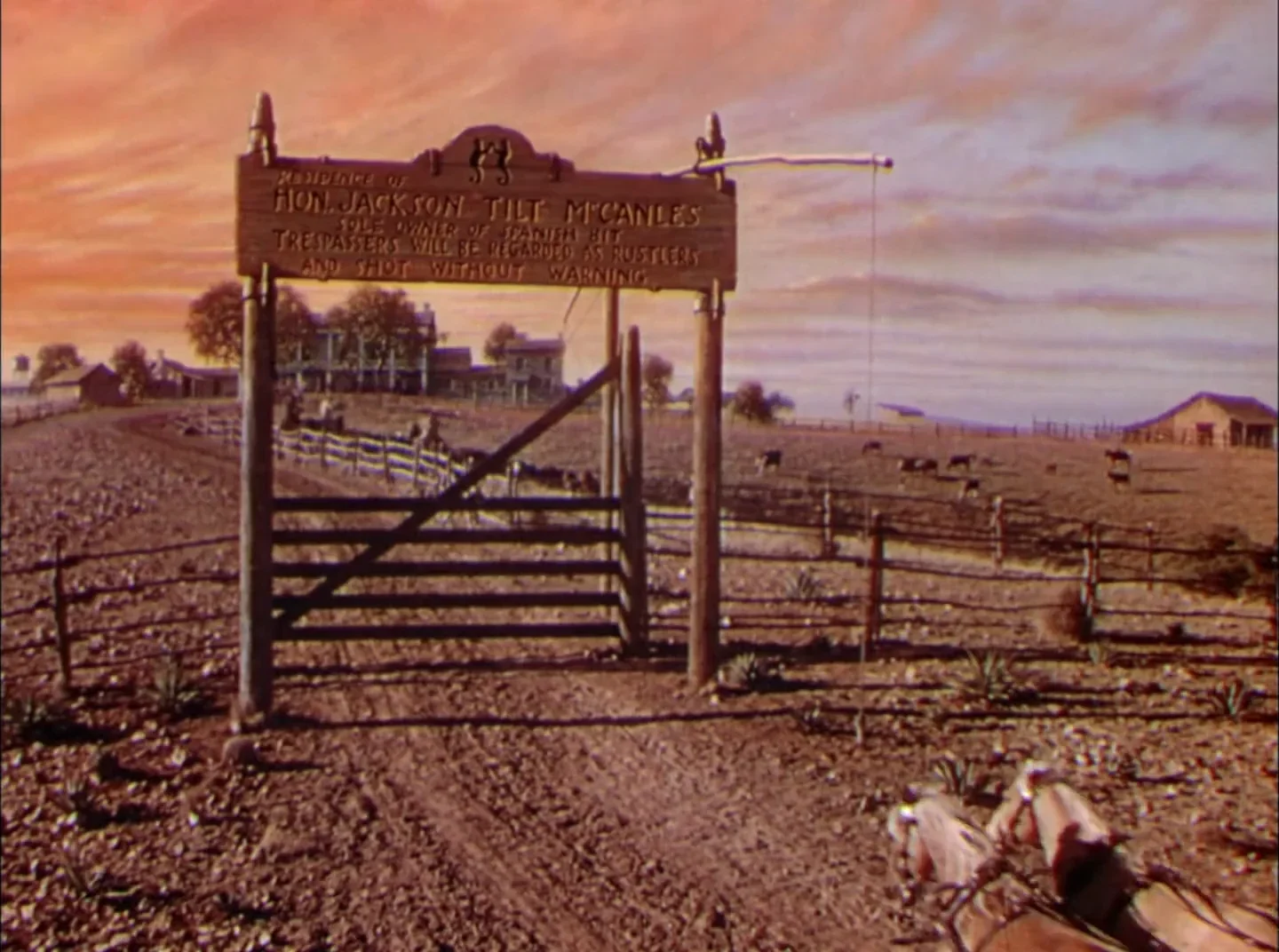
When Lewt does show himself in daylight, his appearances are always sensational. His peacock feathers are most effective when brilliantly illuminated and on display for a spectator. Such is the case when Pearl watches him break a wild horse the morning after he succeeded in breaking her resistance to him. Lewt's prowess at animal husbandry naturally prompts her to fantasize about him as a husband. Just as the bronco buster slips a bit into the mouth of the rebellious horse, Lewt is in effect slipping Pearl into the restraints of Spanish Bit, which is the official name of the McCanles ranch. Spanish Bit refers to an unusually shaped apparatus for livestock control. An illustration of this bit, which is also the McCanles's cattle brand, appears on signage that marks the ranch's property lines. When Jesse directs Pearl's attention to the image engraved upon a marker, the Spanish bit can easily be mistaken for a yoke.
Along the same lines, Newt's sunlit demonstration of his well-trained pinto is purely for Pearl's benefit. Lewt uses the paint as a pawn for her attention. When she receives the animal as a gift, after initially falling from it while riding freeform and bareback, she learns to ride with the useful constraints of saddle and harness, even as Lewt harnesses her into compliance and control.
Sunlight also illuminates Lewt's fratricidal confrontation with Jesse on the main street of Paradise Flats. The showy gunplay is a prelude to Lewt's final flight from justice – when he creeps up the side of Squaw's Head Rock prior to his duel in the sun. The fugitive is a creature accustomed to the protective shade of a rock, but at the end of the trail the lout is exposed and vulnerable.
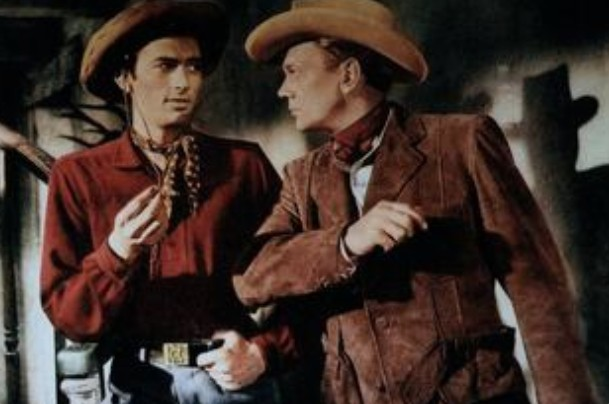
Lewt is an early example of the recurring character of the rebellious son in westerns. The generational conflict they create raises provocative questions about the future of the West. In different ways, both of the rancher's sons rebel against the senior McCanles, with Lewt becoming a prodigal, and Jesse taking a high road by rejecting the narrow-mindedness and greed with which his father enabled and corrupted Lewt. Two years after the making of Duel in the Sun, Howard Hawks's Red River would also present a generational conflict, not just between characters, but between differing possibilities for the future direction of the West's cattle industry. Over time, the movie sons of the Western range became more clearly prodigal and served as pessimistic signals that the West's future might not be in good hands. Earl Holliman's whiny rendition of bully and brat Rick Belden in John Sturges's Last Train from Gun Hill (1959) corresponded to a mid-century American fascination with privileged and delinquent youth. Not long after, Paul Newman's Hud (1963) offered a decidedly cockier treatment of the role, when for the first time the untamed son defies convention by staying put and assuming control of the ranch, rather than leaving willingly or unwillingly. The worrisome transition of leadership in the final scene of Hud can be imagined as an alternate ending to Duel in the Sun, if Lewt were to survive and inherit his father's spread.
The theme of rival brothers would also reappear in westerns. The differently tempered McCanles brothers predate and predict sibling rivalry in The Tall Men (1955) and The Sons of Katie Elder (1960). The trope was revived in the late 20th century by narratives of rival outlaw brothers, such as The Long Riders (1980) and From Dusk to Dawn 3: The Hangman's Daughter (1999). Jesse and Lewt McCanles could be inspirations for the tragic rivalry in Legends of the Fall (1994) between brothers Tristan (Brad Pitt) and Alfred (Aidan Quinn). More recently, George Burbank and his malicious sibling Phil in Thomas Savage's 1978 novel The Power of the Dog, played by Jesse Plemmons and Benedict Cumberbatch in the 2021 film adaptation, bear a haunting resemblance to the even-keeled Jesse McCanles and his self-destructive sibling Lewt.
Jesse openly rejects his father's call for vigilante violence to stop the advance of the railroad across their land. Cast out of his father's household for his disloyalty, Jesse plans a career in public service, telling his father he would like for a McCanles "to give something back to this state, not just take from it." Jesse imagines that Paradise Flats could "become a real town someday." While his idealism is admirable, it also shows that some of Jesse's beautiful dreams, like those of Pearl and the daydreaming servant Vashti (Butterfly McQueen), will never become reality. A welcome sign to Paradise Flats calls the town "the Paris on the Pecos." However, cultural progress and advancing human enlightenment in the late 19th century are bound to leave behind intractable pockets of the old ranch owner's racist and isolationist entrenchment. By tagging the senator as a Northerner early in the film, Selznick reminds us that racist ideology is a universal human propensity with little regard for regional cultural identity. Similarly, Duel in the Sun avoids portraying the West as a monolithic culture that is intent on meeting the future in forward-looking lockstep. Henchmen and ideological inheritors of the rancher's mindset, such as his odious lackey Sid (Scott McKay) will carry the old man's backward beliefs into the next generation. What Jesse will accomplish with his intended relocation to Austin, the state capital, remains an open question, but his stomping ground of Paradise Flats is Paradise Lost.
The contest of good vs. bad and the slender chances of finding paradise are as prominent in the last act of Selznick's script as they are in the early scenes, with Pearl's internal dilemma serving as the constant fault line. When Jesse asks her if she loves Lewt, she replies "Love him? I hate him!" Yet even after the cad dashes her dream of becoming his bride, she remains trapped in fatal attraction to him. Too late, Lewt's utterance of the longed-for L-word softens her rage, but only after their duel of wills has become murderous.
After his brother's aggression pre-empts his courtship of Pearl, Jesse moves on to Helen (Joan Tetzel), a more reputable choice of life partner. In a bizarre display of liberal embrace, Helen accepts her new husband's former (and perhaps current) love interest. Helen's extraordinary invitation for Pearl to live with the newlyweds mirrors Laura Belle's earlier recruitment of Pearl to live at Spanish Bit. In both cases, Pearl's lot is to become the marginalized outsider and tolerated interloper. If she were to join Helen's and Jesse's household, one wonders if Pearl, as a single non-white woman with no foreseeable prospects, would find herself on a plane with Butterfly McQueen's servant character Vashti, who slavishly asks her employer Laura Belle for permission to marry. With no beaux in sight, Vashti's request merely expresses another beautiful dream that is as vapid as Pearl's disappointed hopes for a husband.
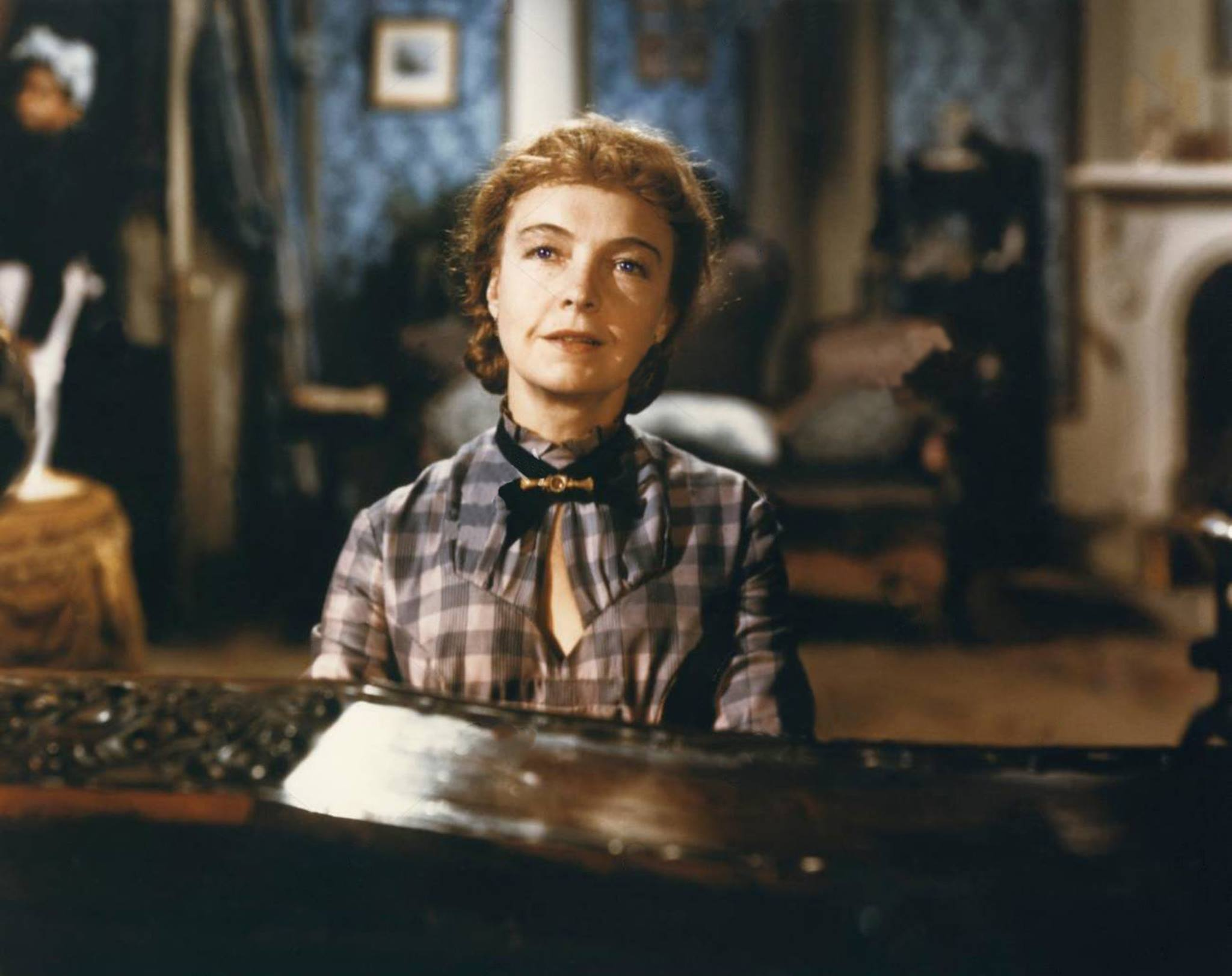
The cast of Duel in the Sun benefited from established actors such as Lionel Barrymore and Lillian Gish, as well as from the young and promising talents of Joseph Cotten, Gregory Peck and Jennifer Jones. Director King Vidor frequently photographs the venerable Lillian Gish as she faces the camera. Laura Belle, a former Southern belle, is a deferential character who nonetheless possesses the ability to confront. (Director Charles Laughton was surely aware of Gish's performance here. The character anticipates her 1954 role as the determined protector of children in The Night of the Hunter.)
Lionel Barrymore's nastiness in the role of Senator McCanles closely resembles that of the other grouch he played that same year, the evil Mr. Potter in It's a Wonderful Life (1946). Laura Belle's wheelchair-bound spouse is most frequently shot in patrician profile. The couple, when seen together, sit at right angles to one another, rather than face to face. The progenitors of the family do not see eye to eye. The discord in the older generation, sustained by an alchemy of domineering and enabling behaviors, engenders even greater turmoil for their offspring.
The senator's wheelchair is akin to a throne. McCanles skillfully exploits his disability to help legitimize ruthless anger with a veil of victimhood. If a king is physically diminished, he must assert himself all the more forcefully to secure the continued, even enhanced admiration of his followers. The senator theatrically mounts a horse (or is planted on it) in an attempt to defend his kingdom from the railroad that threatens to lay tracks across his land. Though the mounted McCanles is statuesque, like the Squaw's Head profile, his endurance in the saddle is far more tenuous than the durability of the towering rock, and he is about to topple from his perch.
Reading about westerns is good. Watching them with a crowd is better.
Join us at the twelfth annual Go West Film Festival — November 9–14, 2026, in downtown Greeley. Every screening is free, and the conversations afterward are the whole point.
Despite its grim portrayal of endemic discord, Duel in the Sun does leave the viewer with signs of hope for future harmony. Leaving the restraint of Spanish Bit behind, Jesse and Helen suggest a distant possibility for unity among the living. Otherwise, however, reconciliation only appears to be possible when it occurs belatedly and without lasting impact. For example, an unexpected gush of narrative exposition precedes Laura Belle's dramatic surrender to consumption. Before her demise, she hears her hardheaded husband soften with a 180-degree turnabout as he recalls the reason for his disability. In a tearful confession filled with self-recrimination, the senator belatedly professes his love for Laura Belle. Moved to forgiveness, Laura Belle struggles from her deathbed to clutch her husband's shoulder as she expires. The composition of this shot is a pieta of sorts and prefigures its matching image in the subsequent conciliatory death clutch of Lewt and Pearl.
In the second decade of the 21st century, viewers can find echoes of contemporary authoritarianism in the character of Senator Jackson McCanles. He despises Pearl in part because she reminds him of Laura Belle's earlier suitor Chavez, the Southern gentleman who was a rival not only in courtship, but potentially also in Civil War hostilities. Beyond the personal motivation, McCanles also shows no respect for Native Americans in general. (While "Pocahontas" would later become the derogatory epithet of choice in 21st century presidential politics, the senator uses the word "papoose" in reference to Pearl.) He is terrified at the thought of a "half-breed squaw" repossessing Spanish Bit through marriage to Lewt, and he is greatly relieved when Lewt assures his father that he merely intends to use Pearl and discard her. While son Jesse views the coming railroad as welcome progress, even if only as a practical improvement over outmoded cattle drives, the senator's opposition to the rail line reflects a familiar symbiosis of deep-seated xenophobia and a desperate desire to consolidate power and cling to it. After all, the elder McCanles argues, "that same railway will ship a lot of immigrants who will start voting . . . ."
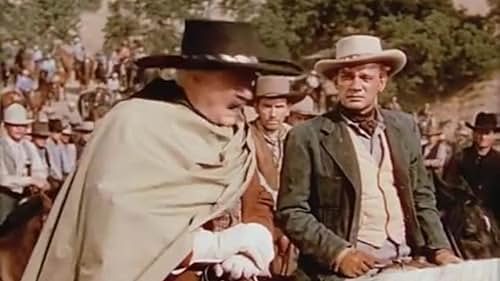
The senator's rallying call for a vigilante mob to interrupt the work of the track crew is a wild turning point in the narrative. Preceded by a symphony of ranch bells, intercut with the clanging bell of the locomotive, the blowhard senator asserts inexplicably charismatic control over his minions and commences a charge reminiscent of the Civil War. Wide-angle pans and traveling shots escalate the tension of an impending clash as a multitude of horsemen bound across the screen from left to right, while the locomotive steadily approaches from right to left. The senator's friend Lem Smoot (Harry Carey) reminds McCanles that he had the chance to dispute the railroad's claim of eminent domain in court, by legal means. Instead, the egomaniacal property owner, who is equal parts authoritarian and vulgarian, chose to ignore judicial means of resolution and take the law into his own hands. Gesturing to a long line of armed followers, he responds "There's my law right there."
Unlike the events of January 6, 2021, seventy-five years after the making of the film, the confrontation at the ranch does not go off the rails. While the Cavalry was conspicuously absent from the U.S. Capitol on that fateful day, it arrives at Spanish Bit with Hollywood precision and saves the day. As the Stars and Stripes flutter in a standard bearer's grip, the imperious old bully backs down. Similarity to the 45th president diminishes when the rancher recovers an appreciation for the rule of law: "I once served under that flag. I'll not fire on it." Finally, McCanles completely distances himself from contemporary American authoritarianism with the admission to his friend Lem, "I must have been wrong about a lot of things."
The promotion of Duel in the Sun in 1946 touted David O. Selznick as "the producer who gave you GONE WITH THE WIND." The quest to replicate or at least live up to his mega success from seven years earlier is a clear motivation for Selznick's move west. The sprawling story drags the plantation South of his earlier hit into sprawling Western ranchland, on which sits a familiarly columned "big house." Selznick even re-employs Butterfly McQueen in the role of a house servant. Like their cinematic cousins at Tara, the cast of Duel in the Sun are variously spoiled, deprived, roguish, innocent, hateful, hospitable, crusty and clear-eyed. Neither Pearl nor Lewt has a close counterpart in Gone with the Wind, yet they share DNA with the self-inflicted vulnerability of Scarlet O'Hara and the callous assertiveness of Rhett Butler.
While Gone with the Wind sets its tumultuous love story against the backdrop of the secessionist South, the saga of Pearl and Lewt in Duel in the Sun plays out in America's post-Civil War West. Both locations are sites of momentous change. However, the American West and its immutable landscape serve as a unique place where natural history intersects with human history. In contrast to the beautiful but short-lived desert flower that symbolizes Pearl Chavez in the film's opening narration, the stark, ambiguous features of Squaw's Head Rock remain constant. The ethnicity of its face is humanly imposed rather than geologically evident. Craggily masculine attributes confound its feminine facial features. The final zoom shot that flies up and away from the couple dying in the desert confirms Squaw's Head Rock as the natural locus for the shared fate of Pearl and Lewt. Neither of them is ever to be seen again, but the rock stands as a monument to a love that is gone with the wind.
The advance of Union bluecoats threatened the order of things in Gone with the Wind. In Duel in the Sun that same prevailing force has become the guarantor of regular order at Spanish Bit. Even so, as in Gone with the Wind, entrenched privilege is subject to historic change. A mechanized future of open minds on the open range barrels toward the patriarchal ranch with the force of a locomotive. We cannot know if David O. Selznick and his directorial team anticipated the need for a windfall of open mindedness in the American future. The film's 21st-century viewers are now the stewards of that beautiful dream.
© 2026 David Caldwell. All Rights Reserved.
Film Details: Duel in the Sun (1946)
| Director | King Vidor (additional uncredited direction by Josef von Sternberg, William Dieterle, William Cameron Menzies, and others) |
| Producer & Writer | David O. Selznick (screenplay adapted from the novel by Niven Busch) |
| Cast | Jennifer Jones, Gregory Peck, Joseph Cotten, Lionel Barrymore, Lillian Gish, Walter Huston, Herbert Marshall, Butterfly McQueen, Harry Carey |
| Music | Dimitri Tiomkin |
| Narrator | Orson Welles (uncredited) |
| Runtime | 128–144 minutes (varies by version; roadshow edition includes overture and exit music) |
| Genre | Western, Drama, Romance |
| Box Office | $10 million in domestic rentals (highest-grossing film of 1946) |
| Go West Screening | Featured at the 2023 Go West Film Festival in Greeley, Colorado |
The Legacy of Duel in the Sun in Western Cinema
When Duel in the Sun arrived in theaters in late 1946, it was one of the most expensive and most heavily promoted films Hollywood had ever produced. David O. Selznick spent an estimated $6 million on production alone — a staggering sum at the time — and poured another $2 million into a then-unprecedented saturation advertising campaign. The result was the highest-grossing film of 1946, though the massive costs meant the picture barely broke even.
The film's cultural impact, however, far outlasted its balance sheet. Contemporary critics were polarized. Some dismissed it as overblown melodrama — the nickname "Lust in the Dust" dogged the picture from its earliest press screenings. The Catholic Legion of Decency condemned it, and several local censorship boards demanded cuts to its more provocative scenes. Yet the controversy only fueled public curiosity, and the film became a genuine cultural event.
From a cinematic standpoint, Duel in the Sun helped redefine what the western genre could contain. Its unflinching treatment of sexuality, racial identity, and female desire within a frontier setting opened doors that later filmmakers would walk through. The "adult western" movement of the 1950s — including films like The Searchers (1956), 3:10 to Yuma (1957), and the psychological westerns of Anthony Mann — owes a debt to Selznick's willingness to push the genre beyond simple tales of cowboys and outlaws.
The film's influence on the portrayal of complex, morally ambiguous female protagonists in westerns continued for decades. Pearl Chavez stands as an early precursor to characters like Vienna in Johnny Guitar (1954), Jill McBain in Once Upon a Time in the West (1968), and the women of Kelly Reichardt's revisionist westerns. Her biracial identity and the film's (however imperfect) engagement with questions of race in the American West were also ahead of their time for a major studio production.
If You Enjoyed This Film
Viewers drawn to the themes explored in Duel in the Sun may also appreciate these related westerns, many of which have been featured or discussed at the Go West Film Festival: Red River (1948), Howard Hawks's own exploration of generational conflict on the cattle trail; Johnny Guitar (1954), Nicholas Ray's fiercely unconventional western starring Joan Crawford; Hud (1963), Martin Ritt's portrait of a prodigal son poisoning his family's legacy; The Power of the Dog (2021), Jane Campion's meditation on toxic masculinity and brotherly rivalry in the early 20th-century West; and The Searchers (1956), John Ford's landmark examination of obsession and racial hatred on the frontier.
Frequently Asked Questions
What is Duel in the Sun about?
Duel in the Sun (1946) is an epic western produced by David O. Selznick that tells the story of Pearl Chavez, a biracial orphan taken in by a powerful Texas ranching family. Pearl becomes caught between two brothers — the virtuous Jesse and the reckless Lewt McCanles — in a passionate, destructive love triangle set against the backdrop of the post-Civil War frontier. The film explores themes of race, gender, desire, and the clash between entrenched power and social progress.
Who directed Duel in the Sun?
King Vidor is credited as the primary director of Duel in the Sun. However, several other directors contributed uncredited work on the film, including Josef von Sternberg, William Dieterle, William Cameron Menzies, Otto Brower, and Sidney Franklin. Producer David O. Selznick maintained close creative control throughout the production.
Why was Duel in the Sun controversial?
The film generated significant controversy upon its release for its frank depiction of sexuality and desire, particularly through the relationship between Pearl Chavez and Lewt McCanles. The Catholic Legion of Decency condemned the film, and multiple censorship boards demanded cuts. Its treatment of race — centering a biracial protagonist in a major studio western — was also unusual and provocative for the era. The film earned the popular nickname "Lust in the Dust."
Where can I watch Duel in the Sun?
Duel in the Sun is available on physical media (DVD and Blu-ray) and may be available for streaming on platforms like Plex. Availability on major streaming services changes frequently, so checking JustWatch for current options is recommended.
What is the Go West Film Festival?
The Go West Film Festival is a free annual western film festival held each November in Greeley, Colorado. Founded in 2014, Go West celebrates classic and contemporary western cinema while fostering community dialogue about the social and environmental issues shaping the American West. Films are screened at the High Plains Library District's LINC and the Kress Cinema & Lounge. The twelfth annual festival is scheduled for November 9–14, 2026.

About the Author
David Caldwell is a founding board member of the Go West Film Festival, which he helped establish in 2014. Originally from the Midwest, David followed the western rainbow toward the purple mountain majesties of Colorado, where he enjoyed a long career in university teaching and research. His academic work includes courses on film reception and film history. David has attended numerous film festivals in the United States and Germany, bringing a deep well of scholarly and cinematic experience to his writing on the western genre.