
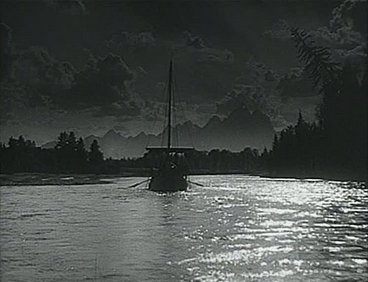
Howard Hawks's The Big Sky (1952) takes the viewer on a bold adventure reminiscent of the Lewis and Clark Expedition. Homespun storytelling by actor Arthur Hunnicutt, delivered with his unique drawl, produces the thread of continuity that pulls a keelboat crew up the Missouri River from St. Louis into what we now know as the big sky country of Montana. The filmmakers substituted the more dramatic Grand Tetons and the Snake River for the Sawtooth Range and the Missouri. Cinematographer Russell Harlan, who photographed numerous westerns for director Howard Hawks, beautifully incorporates the majestic Western backdrops into the visual experience, even as he avoids the appearance of a scenic travelogue and instead remains focused on the cast members.
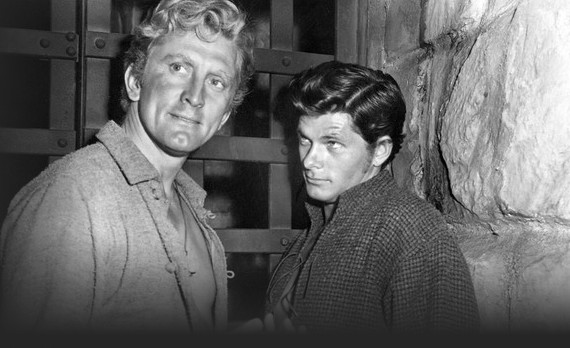
Hunnicutt, in his role as Zeb Calloway, is the wizened frontiersman hoping to lead a band of fur traders far enough upriver to profit from swaps with the Blackfeet and any other Indians docile enough or gullible enough to trade furs for blankets and jugs of whiskey. Calloway's nephew Boone Caudill (Dewey Martin) is eager for adventure and joins the group, along with his buddy Jim Deakins (Kirk Douglas). The wilderness survival skills of the two young men prove vital to the success of the enterprise, and their lusty spirit, tempered by values such as loyalty and fairness, leads to much of the film's suspense and action. Calloway and his young companions flourish in open expanses of back country. However, they chafe in the chaotic urban closeness of their embarkation point, especially when they must share the confinement of a St. Louis jail cell before they can get underway. Constant mobility on a vast river under a boundless sky counterintuitively creates a pure sense of place and also forges genuine closeness among the travelers. In addition to its classification as a western, The Big Sky can also be called a buddy film and a precursor to the road movie.
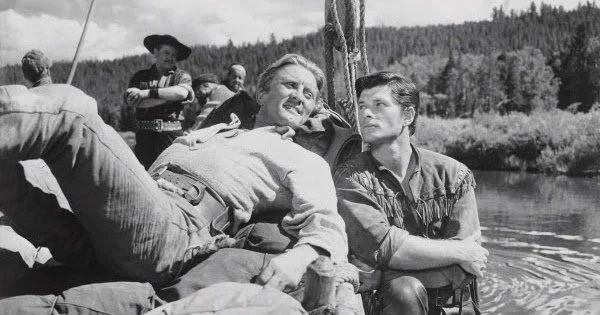
Hunnicutt's acting competence is matched by the easy-going swagger of Kirk Douglas, whose mischievous smiles are occasionally wiped off his face by a quick-tempered and hard-hitting Dewey Martin, still in good form after his boxing role in The Golden Gloves Story (1950). Despite his lesser acting experience, Martin's pairing with Douglas does not suffer from discrepancies in talent. The entire supporting cast, including the largely French-speaking boat crew, an ensemble of surly antagonists, and the natives who must put up with these tourists likewise hinge together as a compelling cinematic collective.
★ From the Festival That Brings You These Essays ★
See Westerns Like This on the Big Screen
The Go West Film Festival screens classic and contemporary westerns every November in downtown Greeley, Colorado — with filmmaker conversations, live silent-film accompaniment, and free admission, always.
NOVEMBER 9–14, 2026 · KRESS CINEMA & LOUNGE · FREE
DISCOVER THE FESTIVAL
At times Hawks appears to have been frustrated with the material. He resorts to voice-over narration by Hunnicutt to stitch together the story's various chapters. It's always a relief when Zeb returns to the frame and engages in direct dialogue with the other actors, rather than explain events as a disembodied voice. His inimitably sage simplespeak always prompts a smile, but during the voice-overs, Hunnicutt's purely functional lines have the lyrical panache of a traffic report. The multiplicity of writers for the screenplay likely contributes to the episodic, sometimes choppy nature of the storyline and prevents an otherwise enjoyable film experience from flowing like, well, a river.

The characters played by Hunnicutt, Douglas and Martin, along with the other crewmen, constitute the good guys among the cast. The bad guys are a bunch of even greedier and less honorable fur traders who had preceded Calloway's keelboat upstream. The low-down varmints try to monopolize trade with the Indians, and they are not above using violence and treachery to thwart the protagonists' expedition. The villains also differ from the good guys by building a permanent structure. Their log trading fort, outfitted with cannon, is an unwelcome indication to the natives that white settlement and militarization are on the way. By contrast, the Calloway crew resembles the forebears of riverboat cruises nearly two centuries in the future, when passengers swarm ashore, haggle with the locals over their wares, fill their shopping bags, and then leave. In addition to the stubborn river current and the countless natural hazards that the expedition must confront, many megawatts of narrative energy are generated by the turbulent relationship between these two groups of white frontiersmen.
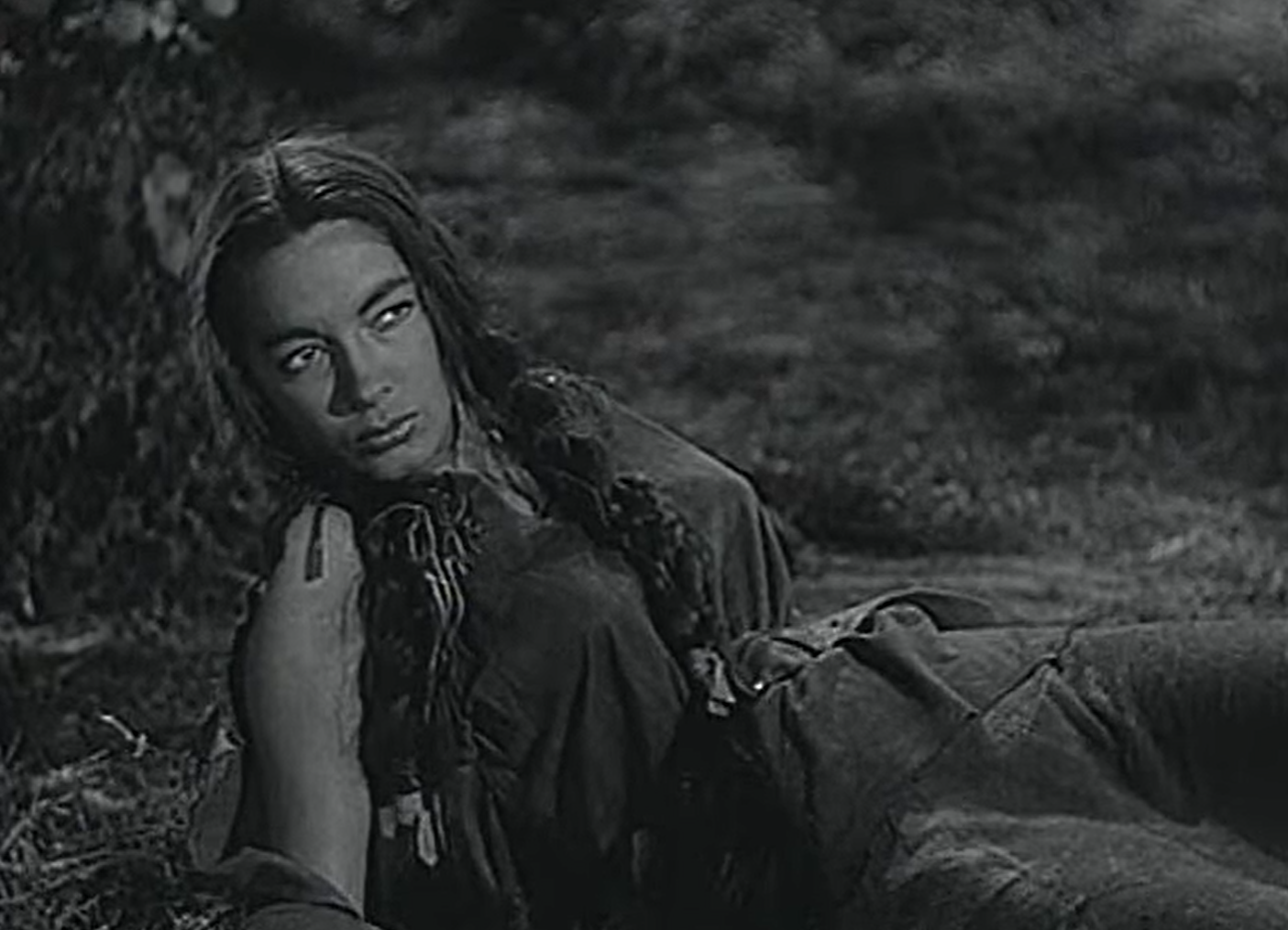
Rather than portraying Indians as endemic enemies, the film represents native tribes as an oppositional force only when they are deceived by the malicious white traders and provoked into attacking the good guys. Dewey Martin's character struggles with a blind prejudice against Native Americans, but after the group picks up a lovely indigenous woman named Teal Eye, Boone's eyes open enough to gaze into hers. His opinions on race gradually soften in the glow of their mutual attraction. Kirk Douglas, as the equally available hunk Jim, is likewise attracted to her, and a triangular competition adds another dimension to the narrative's suspense. Elizabeth Threatt, who was half Cherokee, is a regal presence as Teal Eye, the only film role of her career. Unlike Sacagawea, who supposedly helped Lewis and Clark communicate with native peoples along the way, Teal Eye never understands nor speaks a word of English. Because Boone is likewise ignorant of her language, Hawks must portray the rocky progress of their relationship almost entirely through visual language and unrequited monologue. The hurdles Boone and Teal Eye must clear to become partners form a counterpart to the obstacles the traders overcome as they survive the wilderness and bring their furs to market.
Reading about westerns is good. Watching them with a crowd is better.
Join us at the twelfth annual Go West Film Festival — November 9–14, 2026, in downtown Greeley. Every screening is free, and the conversations afterward are the whole point.

Teal Eye's exotic allure for both Boone and Jim was prefigured by their three-way flirtations with a sexy French barmaid back in St. Louis. (The fleeting dalliance turned out to be a prelude to the men's subsequent incarceration.) Like Teal Eye's indigenous language, the French spoken by the coquette was unknown to the two pals but similarly presented no impediment to their interest. The exoticization of the film's few women characters, a gender whose strange ways Zeb Calloway considers incomprehensible, contrasts with attempts at cosmopolitanism elsewhere. One sees a clear effort to present the Blackfeet and other tribes as more accessible and less alien than whites might think. Though he is mystified by females, Hunnicutt's Calloway moves with ease among the Indians (at least the men) and speaks their languages fluently. His simultaneous interpretation appears to be impeccable during commercial negotiations and at crucial moments in his nephew's conflicted courtship of Teal Eye.

Equally clear is that a lack of racial bigotry is not synonymous with worldliness. A majority of Calloway's keelboat crew are French trappers and merchants, yet every time his second-in-command addresses the captain in the language of the old country (yes, the crewman's name is "Frenchy"), Calloway has no inkling of what the man is saying and barks "Talk English!" (One suspects here the pens of two different screenplay writers who may also have had difficulty communicating with each other, or alternatively, an unresolved difference of approach to the material, in which the screenplay is at odds with the intentions of author A. B. Guthrie, Jr., who wrote the source novel.)
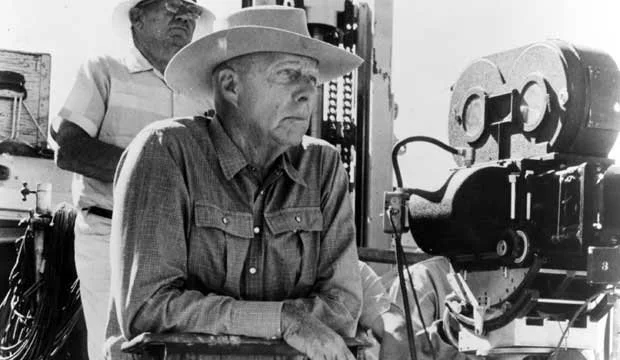
The Big Sky is one of many westerns in which pioneers venturing out from civilization are dwarfed by the overwhelming natural environment of the Wild West. In the approximately contemporaneous film Westward the Women (1951) and more recently in films such as The Revenant (2015) and the work of Kelly Reichardt (Meek's Cutoff, 2010 and First Cow, 2019), we also see antagonisms and affinities among the characters, along with an overarching conflict between the pioneers and the forces of nature that may well kill them. In those films the narrative emphasis tips toward the precarious struggle for survival in the West. Relationships among the adventurers are also a natural human occurrence, but their significance often becomes moot when the participants are threatened with extinction in the wilderness. Despite its title, The Big Sky favors the smaller scale suspense of strained friendships, fraught personal loyalties, petty disputes, and unlikely romance. Thunderous skies and the roar of a raging river are constant threats, but Hawks tends to consider them background noise for the stormy and reliably entertaining dramas that people can stir up for themselves.
© 2026 David Caldwell. All Rights Reserved.
Film Details: The Big Sky (1952)
| Director | Howard Hawks |
| Screenplay | Dudley Nichols, Ray Buffum (based on the novel by A. B. Guthrie, Jr.) |
| Cast | Kirk Douglas, Dewey Martin, Elizabeth Threatt, Arthur Hunnicutt, Buddy Baer, Steven Geray, Jim Davis |
| Cinematography | Russell Harlan |
| Runtime | 122–140 minutes (preview cut was 140 min; general release trimmed to 122 min) |
| Genre | Western, Adventure, Drama |
| Awards | Academy Award nomination for Best Supporting Actor (Arthur Hunnicutt) |
| Source Novel | The Big Sky by A. B. Guthrie, Jr. (1947) — winner of the Pulitzer Prize for Fiction in 1950 |
Howard Hawks and the Western Adventure Film
The Big Sky occupies a distinctive place in Howard Hawks's filmography. Hawks was one of classical Hollywood's most versatile directors, equally at home in screwball comedies (Bringing Up Baby, His Girl Friday), hard-boiled crime films (Scarface, The Big Sleep), and westerns. His approach to the western genre consistently emphasized the camaraderie and friction between small groups of competent professionals thrown together under pressure — a sensibility that makes The Big Sky one of his most characteristic films, even if it remains less well known than Red River (1948) or Rio Bravo (1959).
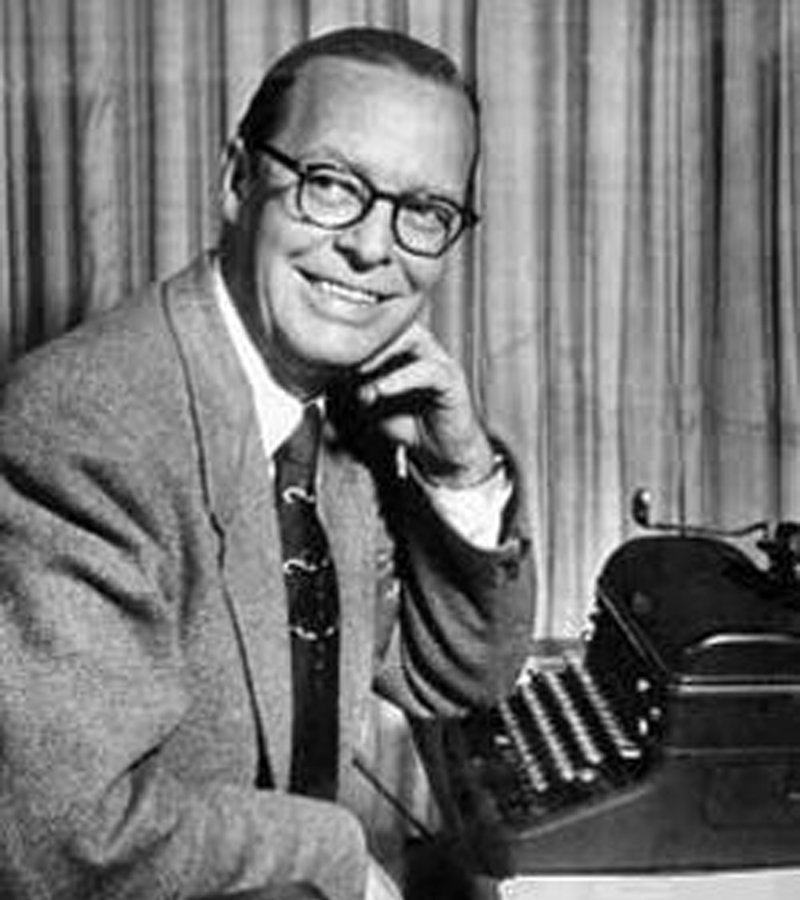
The film is adapted from A. B. Guthrie, Jr.'s 1947 novel of the same name, which won the Pulitzer Prize for Fiction in 1950. Guthrie, who grew up in Montana and spent his career writing about the settlement of the American West, brought an unusual level of historical specificity and ecological awareness to his fiction. His depiction of the 1830s Missouri River fur trade — a world of keelboats, beaver pelts, and fraught encounters between white traders and indigenous peoples — gave Hawks and screenwriter Dudley Nichols rich material to work with, even if the episodic nature of the source novel posed structural challenges for the film.
Arthur Hunnicutt's Academy Award-nominated performance as the grizzled frontiersman Zeb Calloway was widely praised and remains the film's most celebrated element. Hunnicutt, a character actor from Arkansas, brought an authenticity to frontier roles that few Hollywood performers could match. His work in The Big Sky established the template for a certain kind of western storyteller — the laconic old-timer whose folksy exterior conceals hard-won knowledge of both the land and the people who inhabit it.
Russell Harlan's black-and-white cinematography, shot on location in the Grand Tetons of Wyoming, is another of the film's lasting strengths. Harlan's ability to capture the grandeur of the Western landscape while keeping the human figures central to the frame reflects Hawks's conviction that the most compelling drama always lies between people, not in the scenery surrounding them.
If You Enjoyed This Film
Viewers who appreciate the frontier adventure and buddy-film dynamics of The Big Sky may also enjoy: Red River (1948), Hawks's own epic cattle-drive western starring John Wayne and Montgomery Clift; Westward the Women (1951), William Wellman's overlooked gem about a wagon train of mail-order brides; The Revenant (2015), Alejandro Inarritu's visceral survival story set in the 1820s fur trade; Meek's Cutoff (2010), Kelly Reichardt's minimalist pioneer drama; and First Cow (2019), Reichardt's gentle tale of friendship and commerce on the early Oregon frontier.
Frequently Asked Questions
What is The Big Sky (1952) about?
The Big Sky is a 1952 western adventure film directed by Howard Hawks. Set in the 1830s, it follows a keelboat expedition up the Missouri River from St. Louis into the uncharted wilderness of what is now Montana. Three frontiersmen — veteran Zeb Calloway, his nephew Boone Caudill, and Boone's friend Jim Deakins — navigate treacherous rapids, hostile rival traders, and complex encounters with Blackfeet and other Native American peoples. A cross-cultural romance between Boone and a Blackfoot woman named Teal Eye adds emotional depth to the frontier adventure.
Is The Big Sky based on a true story?
The Big Sky is based on the 1947 novel of the same name by A. B. Guthrie, Jr., which won the Pulitzer Prize for Fiction in 1950. While not a retelling of a specific historical event, Guthrie drew heavily on the real history of the Missouri River fur trade in the 1830s and the Lewis and Clark Expedition for his setting and themes. The story is often compared to the Lewis and Clark journey for its depiction of an expedition pushing upriver into unknown territory.
Where was The Big Sky filmed?
Although the story is set along the Missouri River in Montana, The Big Sky was filmed on location in the Grand Teton region of Wyoming, using the Snake River as a stand-in for the Missouri. Cinematographer Russell Harlan captured the dramatic mountain scenery to create the film's immersive frontier atmosphere.
Where can I watch The Big Sky (1952)?
The Big Sky is available for free streaming on Tubi and Plex. It can also be rented or purchased on Amazon Video, Apple TV, and Fandango at Home. Physical DVD copies are available through Amazon.
What is the Go West Film Festival?
The Go West Film Festival is a free annual western film festival held each November in Greeley, Colorado. Founded in 2014, Go West celebrates classic and contemporary western cinema while fostering community dialogue about the social and environmental issues shaping the American West. Films are screened at the High Plains Library District's LINC and the Kress Cinema & Lounge. The twelfth annual festival is scheduled for November 9–14, 2026.

About the Author
David Caldwell is a founding board member of the Go West Film Festival, which he helped establish in 2014. Originally from the Midwest, David followed the western rainbow toward the purple mountain majesties of Colorado, where he enjoyed a long career in university teaching and research. His academic work includes courses on film reception and film history. David has attended numerous film festivals in the United States and Germany, bringing a deep well of scholarly and cinematic experience to his writing on the western genre.